Showing posts with label tribal art. Show all posts

Wednesday, April 22, 2015

Larrakitj : Aboriginal memorial poles by Wukun Wanambi

An installation by contemporary Aboriginal Australian artist Wukun Wanambi, on view now at The British Museum, addresses a series of important ideas about ancestral power, the significance of land and the search for meaning. Aboriginal Australian memorial poles – known as larrakitj – are hollow coffins created to hold the bones of the dead in secondary burial. Placed in groups on significant sites and painted with clan symbols, they are left to deteriorate with wind and weather. Contemporary artist Wukun Wanambi belongs to the Yolngu people of northern Arnhem Land and has worked innovatively with this longstanding art form for over a decade. Wukun’s work is an exploration into traditional forms with deep connections to clan, territory and ancestral stories.

Visit the exhibition's official website.

Wukun Wanambi  -  Wetjwitj (detail), 2013

Image courtesy of The British Museum


Tuesday, March 31, 2015

Indigenous Beauty

Drawn from the celebrated Native American art collection of Charles and Valerie Diker, Indigenous Beauty: Masterworks of American Indian Art from the Diker Collection at the Seattle Art Museum features 122 masterworks representing tribes and First Nations across the North American continent. These captivating objects convey the extraordinary breadth and variety of Native American experience in North America. The exhibition shows the deep historical roots of Native art and its dynamism, as well as the living cultures and traditions of Native American groups through to the contemporary era. Indigenous Beauty emphasizes three interrelated themes—diversity, beauty, and knowledge—that relate both to the works’ original contexts and to the ways in which they might be experienced by non-Native visitors in a contemporary museum setting.

For more information, visit the exhibition's official website.


Man's summer coat  -  Naskapi, Labrador  -  1840

Snow goggles  -  Ipiutak, Alaska  -  5th–10th century

Mask  -  Yup'ik, Alaska  -  1916–1918

Katsina  -  Hopi, Arizona  -  1910–1930

Images courtesy of the Seattle Art Museum


Friday, December 19, 2014

Ethiopian Crosses at Jacaranda Tribal

Jacaranda Tribal has just revealed a trio of beautiful Ethiopian crosses dating from the medieval period to around the beginning of the nineteenth century. These gorgeous ceremonial works represent some of eastern Africa's most iconic artistic heritage and one of the oldest Christian traditions in the world. Ethiopia was probably the second country after Armenia to embrace the Christian faith, and there is evidence that Christianity thrived in the country even in the first century AD. For most of Ethiopia's subsequent history, Orthodox Christianity has remained the state religion. Ethiopian crosses are coveted by collectors of medieval art, religious art and tribal art for their stunning beauty and fabulous variety of form.

For more details on these objects and many more, visit www.jacarandatribal.com

Processional cross  -  14th–15th century

Hand cross  -  1780–1830

Hand cross  -  Ca. 1700


Thursday, April 24, 2014

Floral Journey: Native North American Beadwork

Art and spirituality converge with trade and commerce in Floral Journey: Native North American Beadwork, an exhibition currently on view at the Autry National Center of the American West. Through 250 unique objects and related personal stories, the exhibition presents moccasins, bags, dresses, hats, jackets, and other exquisite beaded and quilled items, selected from fifteen cultural institutions and multiple private collections, which together explore how beaded floral designs became a significant artistic motif as well as a means of economic and cultural survival for Native North American peoples.

Visit the exhibition's official website.

Lakota boots  -  Late 19th century

Ojibwe vest  -  1885

Cree gauntlets  -  Canada, 1900

Images courtesy of the Autry National Center of the American West


Tuesday, March 11, 2014

Face to Face

The Israel Museum will open an exhibition entitled Face to Face: The Oldest Masks in the World on March 11. Curated by Dr. Debby Hershman, the show will be a first in many respects, as the 9000-year-old limestone masks that are its subject— twelve of which are known—have never been brought together before, even on their home territory.

Visit the exhibition's official website.


Photos courtesy of The Israel Museum


Thursday, February 27, 2014

L'Atlantique Noir de Nancy Cunard

Eighty years ago, on February 15, 1934, Englishwoman Nancy Cunard (1896-1965), a symbol of the Anglo-Saxon and French avant-garde of the early 20th century, published Negro Anthology. Lavishly illustrated, this 858-page book, resembling a major documentary enquiry, blended popular culture, sociology, politics, history, art history in the form of articles, archives, photographs, extracts from the press, musical scores, eye-witness accounts etc. Through the great themes examined in Negro Anthology, the Musee du Quai Branly will present the transnational artistic, literary and political networks constructed by Nancy Cunard in the years between 1910 and 1930, which have made this anthology a monument to black history.

View the exhibition's official website.


Portrait of Nancy Cunard  -  Man Ray, 1925

Image courtesy of the Centre Georges Pompidou/Musée du Quai Branly


Friday, August 2, 2013

Visiting with the Ancestors

What happens when museum objects go home for a visit? The Blackfoot shirts at Pitt Rivers Museum, collected in 1841, express Blackfoot culture and beliefs. In 2010, Pitt Rivers staff took them home to Canada for a visit so that contemporary Blackfoot people could learn from them and strengthen cultural knowledge and identity. This small exhibition includes three of the shirts and quotes and photographs from the reunions with Blackfoot people.


Shirt with war honors  -  First half of 19th century


Image courtesy of the Pitt Rivers Museum, Oxford


Friday, July 26, 2013

Arts de l'antiquité, uen collection centenaire

Arts de l'antiquité, uen collection centenaire (Arts of Antiquity, a Centenary Collection), on view until October 6 at the Musée Barbier-Mueller in Geneva, reflects the passion of three generations of collectors of ancient art. Begun by Josef Mueller in the early twentieth century, the collection of antiquities at the Barbier-Mueller Museum was enriched by the acquisitions of his son-in-law Jean Paul Barbier-Mueller and of his grandsons. The pieces on display, chosen for their aesthetic quality, are ambassadors of civilization as varied as the Cyclades, Predynastic and Pharaonic Egypt, Greece, and Rome. They are landmarks in this representative tour of the artistic production of the ancient world. The panorama offered to visitors illustrates the major tendencies, the extraordinary diversity, and the vitality of the art of antiquity, from the sixth millennium BC to the third century AD.


Female figure  -  Cyclades  -  circa 2900 BC

Female figure ("Bactrian Princess")   -  Oxus civilization  -  End of 3rd millennium BC

Vase with scorpion-men  -  Southeast Iran  -  2600–2200 BC

Information and images courtesy of the Musée Barbier-Mueller de Genève


Thursday, July 18, 2013

J’arrive, J’aime, Je m’en Vais – Pierre Loti l’Ambigu Exotique

Through September 29, 2013, the new Atelier Martine Aublet at the Musée du Quai Branly will host a show devoted to the unique and fascinating Pierre Loti (born Julien Viaud). J’arrive, J’aime, Je m’en Vais – Pierre Loti l’Ambigu Exotique (I Arrive, I Love, I Leave – Pierre Loti, the Ambiguous Exotic) is an homage to this late nineteenth-century literary ambassador of exoticism. He was a cosmopolitan dandy who cultivated extravagance and was fascinated by the foreign cultures he encountered in the course of his travels as a naval officer. Conceived by Claude Stéfani, curator at the Municipal Museums of Rochefort, the exhibition includes archival documents, photographs, clothing, and all manner of personal effects. 

View the exhibition's official website.


Image courtesy of the Musée du Quai Branly


Saturday, April 27, 2013

Earth Matters: Land as Material and Metaphor in the Arts of Africa

Earth Matters: Land as Material and Metaphor in the Arts of Africa is the first major exhibition and scholarly endeavor to comprehensively examine the rich relationship between African artists and the land upon which they live, work, and frame their days. On view until January 5, 2014 at the National Museum of African Art in Washington, DC, the exhibition brings together approximately 100 exceptional works of art from the late eighteenth to twenty-first centuries.


Buti or nkiba figure  -  Teke, DR Congo  -  Late 19th to early 20th century

Reliquary ensemble  -  Punu, Gabon  -  19th century

Kidumu mask  -  Teke, DR Congo  -  Early 20th century

Nkisi nkondi  -  Yombe, Congo or Angola  -  19th century

Storage vessel  -  Kurumba, Burkina Faso  -  Mid-20th century

Tchif  -  Sunshineland, 1973


Information and images courtesy of the National Museum of African Art


Saturday, April 20, 2013

Métissages: Les collections Denise et Michel Meynet

A new exhibition at the Musée des Beaux-arts de Lyon dedicates itself to works from the collections of Denise and Michel Meynet, moving its focus seamlessly from African art to Japanese furniture to twentieth-century prints. These works complement and mirror one another in a constantly changing display setting. 


Beaded dolls  -  Nigeria  -  Twentieth century


Bracelets for a vodou priestess  -  Benin, Nigeria  -  Early twentieth century

Ikebana basket  -  Japan  -  Twentieth century


Information and images courtesy of the Musée des Beaux-Arts de Lyon


Saturday, March 30, 2013

Sowei Mask: Spirit of Sierra Leone

Sowei masks – unique to the region around Sierra Leone – are worn by senior members of the all-female Sande society during rite-of-passage ceremonies that signify a girl’s transition to adulthood. They are carved expressions of local ideals of feminine beauty, health and serenity that vary widely in their detail. [i]Sowei Mask: Spirit of Sierra Leone[/i], on view now at the British Museum, honors these marvelous creations with a showcase exhibition that explores their history and the development of their forms.

Visit the exhibition's official website.


Wednesday, March 27, 2013

PAD 2013 - Paris


The seventeenth Pavillon des Arts et du Design will take place from March 27-31 in the Jardin des Tuileries in Paris. The event aims to present the best of international achievement in the fields of design, decorative arts, and modern art. It will also offer aficionados of tribal art an exhibition in which four galleries in their field are taking part: Galerie Afrique, Grégory Chesne, Galerie Flak and Galerie Mermoz. 

For more information, please visit the official PAD website.


Saturday, March 16, 2013

Le rire, l'horreur et la mort

This spring the Musée du Quai Branly is presening Le rire, l'horreur et la mort, an exhibition that showcases a selection of posters painted for video clubs that have proliferated in Ghana since the 1980s. These posters illustrate the extraordinary development of film and especially video that accompany and portray the social, urban and technological transformation of the country, between Accra and Kumasi and into rural areas. Other Ghanaian images relating to death are also on view, including ancient Akan funerary heads and incredibly whimsical modern coffins.

View the exhibition's official website.


Information and images courtesy of the Musée du Quai Branly


Monday, March 11, 2013

Ethiopian Processional Cross

In Ethiopia, the cross as a Christian symbol has been developed with more variety of form than anywhere else in the world. The first crosses known in Ethiopia were probably imported from early Christian Egypt around 400 A.D., but the motif eventually took on aesthetics not found elsewhere in Christian culture. This was due to familiar symbols such as the triangle, circle, and also the cross already being in use in pagan belief systems, as well as the special way in which the Abyssinian church absorbed the influences of both its Judaic roots and artistic ideas from Persia, Armenia, and the Islamic world.

This beautiful medieval cross, which is of the processional type, was exquisitely cast with rounded, echoing forms, and would have been held aloft as the finial of a staff or pike. A native repair has been made with the application of metal wire.

For more information on this object and many, many more, please visit us at:


Metal, wire
13th–14th century
H: 8"
Collected by Joseph Knopfelmacher in Ethiopia in the 1970's


Friday, March 1, 2013

Kastom: Art of Vanuatu

Vanuatu is very different from other Pacific nations. Traditional practices known as Kastom remain strong even after a century of dual colonial religious influences. Kastom: Art of Vanuatu presents for the first time the unique collection of arts from this area held by the National Gallery of Australia. In the early 1970s the Gallery contracted an agent to field collect in Vanuatu resulting in the acquisition of nearly two hundred works, a selection of which will be accompanied by other important works from the NGA's Vanuatu collection. 


Information and images courtesy of the National Gallery of Australia

Friday, February 22, 2013

Un artiste voyageur en Micronésie, l'univers flottant de Paul Jacoulet

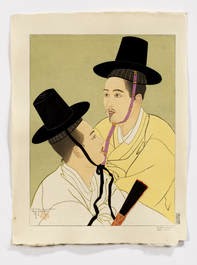
The Musée du Quai Branly will open an intriguing new exhibition on February 26. Un artiste voyageur en Micronésie, l'univers flottant de Paul Jacoulet explores the work of the noted French printmaker, who traveled to Japan in 1899 and would ultimately spent the greater part of his life there. While in Asia, Jacoulet traveled to Korea, China and Micronesia, which he visited numerous times to paint portraits of the inhabitants. Through his engravings and drawings, he represents the Micronesian men and women he encountered in a sensitive and aesthetically distinctive way that is at once intimate, stylish, and ethnographic. 


Information and images courtesy of the Musée du Quai Branly

Thursday, February 21, 2013

Anatomies de l'étrange

On view at the Musée d'histoire naturelle Lille is Anatomies de l'étrangean exhibition that seeks to question the notion of fantasy through its multifaceted collections. Visitors will encounter legendary monsters and extraordinary objects reflecting distant societies, often misunderstood and fantasized.


Friday, October 12, 2012

New Online Sale Exhibition at Jacaranda Tribal

Jacaranda Tribal is now presenting a new sale exhibition of exquisite tribal art from Africa, Oceania, and elsewhere. Our fifteen new offerings include a marvelous Bembe female figure collected by Edmond Dartevelle in the 1930s; a large, lustrous Gambier Islands fish hook carved of a single piece of pearl shell; an astonishingly detailed Javanese keris knife; a beautifully designed Ethiopian processional cross dating from the 13th–14th century; wirework prestige objects from Zimbabwe and South Africa; and more. A selection of highlights from the assemblage are below. For detailed information on these beautiful works and many more, please visit www.jacarandatribal.com


Female figure  -  Bembe, D. R. Congo  -  Early 20th century
Fish hook  -  Gambier Islands  -  Late 19th century
Keris  -  Java  -  Late 19th or early 20th century
Heddle pulley depicting an avian figure  -  Senufo, Côte d'Ivoire  -  Late 19th or early 20th century
Processional cross  -  Ethiopia  -  13th–14th century
Woman's hat  -  Zulu, South Africa  -  Early 20th century
Pair of stools (one featuring a cache box)  -  Nupe, Nigeria  -  Early 20th century
Prestige knife with wirework  -  Shona, Zimbabwe  -  Late 19th or early 20th century