Monday, March 19, 2012

Tribal Art Auction - Lempertz, March 31

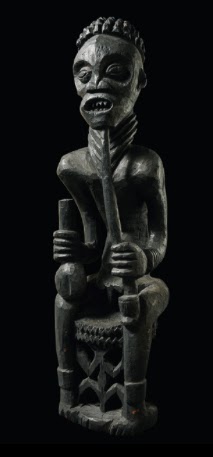
Lempertz of Cologne will present a sale of fine tribal art in Brussels on March 31. Among the lots will be an admirable selection of beautiful works from Oceania and West and Central Africa, the highlight of which comes in the form of a New Ireland uli figure once owned by the German artist Otto Dix.

http://www.lempertz.eu

Uli figure  -  New Ireland
Caryatid stool  - Luba, DR Congo
Ancestor skull  -  Asmat, Papua New Guinea
Mask  -  Vuvi, Gabon
Ivory figurine  -  Lega, DR Congo
   
Zoomorphic bowl  -  Fiji              


Information and images courtesy of Lempertz

Saturday, March 17, 2012

The Coe Collection of American Indian Art at the Met

Currently on view at the Metropolitan Museum of Art in New York, The Coe Collection of American Indian Art features works given and bequeathed to the Museum during the past decade by Ralph T. Coe of Santa Fe, New Mexico. Comprised of some forty objects made in natural materials from stone to animal hide, the installation presents a wide range of Native American objects that come from different times and places, and from numerous distinct peoples.

For more information, visit the exhibition's official website.


Leadership shirt  -  Plains Indian  -  19th century
Basket with feathers  -  Pomo, California  -  Early 20th century
Mosquito mask  - Tlingit, Alaska  -  19th century
Mask depicting a noblewoman  -  Richard Davidson (Haida, b. 1946), British Columbia

Information and images courtesy of the Metropolitan Museum of Art

Thursday, March 15, 2012

Expanding Views of Africa at Stanford University

 Cantor Arts Center at Stanford University opened an enlarged and enhanced reinstallation of its African art galleries last year. Expanding Views of Africa includes 200 works from the collection and key loans, broadens conventional views of African art, from ancient cultures before the dynasties of the Egyptian Pharaohs to contemporary artists.

Visit the Cantor Arts Center's official website.

Bushoong mask  -  Kuba, D. R. Congo
Mask, mwana pwo  -  Luvale, Zambia  -  Late 20th century
Sarcophagus mask of a woman  -  Egypt  -  7th–6th century BC
Sengele, D. R. Congo
Head ornament, tcherot or tereout tan'eraf  - Tuareg, Algeria  -  20th century

Information and images courtesy of Cantor Arts Center, Stanford University

Tuesday, March 13, 2012

Embodying the Sacred in Yoruba Art at Kean University

Embodying the Sacred in Yoruba Art, on view through April 18 at Kean University’s Karl and Helen Burger Gallery, comprises twenty-eight Yoruba masterpieces from Nigeria, Benin, and Togo, all sourced from the collection of the Newark Museum. The pieces in the show, which were produced from the late nineteenth through the twentieth century, highlight the relationship between art and the spiritual world.

Visit the exhibition's official website.


Staff of authority, ipawo ase  -  Nigeria
Crown, ade abetiaja  -  Nigeria, 1970s
Twin figure, ere ibeji  -  Nigeria, 20th century
Sword of authority, ida ase  -  Nigeria, 19th–20th century
Dance vest with Esu figures  -  Nigeria, 19th–20th century
Divination tray, opon ifa  -  Nigeria, first half of 20th century  -  Attributed to Areogun or atelier
Egungun mask  -  Nigeria, 20th century

Information and images courtesy of Kean University and the Newark Museum.

Thursday, March 8, 2012

Expanding Africa at the Newark Museum

For nearly a century, the Newark Museum has been a pioneer among U.S. museums in the collecting and display of African art. Today, the Museum’s nationally known collection includes nearly 5,000 works representing artistic creativity, past and present, from throughout the continent.

Expanding Africa at the Newark Museum: New Visions, New Galleries features exceptional works of art from the Museum’s extensive and ever-growing collection. Bringing together contemporary and historic works in a range of different media, the exhibition seeks to broaden conventional ideas about African art while encouraging dialogue about its constantly evolving definition. The exhibition also introduces the Newark Museum’s initiative to expand its galleries for the exhibit and teaching of African art, the completion of which is planned to coincide with the centennial of this important collection in 2015.

Visit the official website of the Newark Museum.

Female figure  -  Chokwe, Angola  - Late 19th or early 20th century
Many Came Back, 2005  -  El Anatsui
Shawl (lamba akotofahana)  -  Madagascar  -  19th century
Untitled (Seated Woman), 1956–1957  -  Seydou Keita

Text and images courtesy of the Newark Museum

Monday, March 5, 2012

New Acquisitions at Jacaranda Tribal

Our gorgeous assemblage of new acquisitions for February 2012 includes a fine Akan terracotta head; a delicately carved Grebo mask; a pair of beautiful Yoruba ibeji twin figures; a powerful Senufo figurine, and many more.  Visit our online gallery at Jacaranda Tribal for more information on all of the objects below.

Terracotta head - Akan, Ghana 
Maskette - Grebo, Côte d'Ivoire - Early 20th century
Ibeji twin figures - Yoruba, Nigeria - Early 20th century
Female figurine - Senufo, Côte d'Ivoire or Mali - Early 20th century
Stool or headrest - Bongo, Sudan - Early 20th century

Stool - Sudan - Early 20th century

Ivory bracelet - Culture unknown (African)

Masai arm ornament - Kenya or Tanzania - Early 20th century

Headrest - Bari, Sudan - Late 19th or early 20th century
Snuff container - Sotho, Lesotho - Late 19th or early 20th century

Snuff container - Sotho, Lesotho - Late 19th or early 20th century
Pipe with figural bowl - Xhosa, South Africa - 19th or early 20th century
Ladle with figural handle - Zulu, South Africa - Late 19th or early 20th century
Headrest - Tsonga, South Africa - Late 19th or early 20th century

Tuesday, February 28, 2012

Yoruba Ibeji Twins

Ibeji figures represent deceased twins born to Yoruba mothers, who have the highest rate of twin pregnancies in the world. After a twin's death, this small, wooden effigy figure is fed, bathed, clothed, and offered the same loving care that Yoruba women lavish on living infants and especially surviving twins.

This pair of ibeji, from the Egba clan, present a marvelous example of classic Yoruba art. Darkened with a rich patina and sporting vivid coiffures, their deep tones of brown and blue are heightened by the sparing but effective addition of red beads, providing a gorgeous contrast of elemental hues. Scarifications present on the cheeks, chests, and arms complete the range of detail on these carefully crafted twins, subtly but eloquently evoking living identity and persona.