Showing posts with label Musée du quai Branly. Show all posts

Tuesday, July 28, 2015

L'Inca et le Conquistador

L’Inca et le conquistador (The Inca and the Conquistador), a new exhibition at the Musée du Quai Branly, uses artistic creations by the Inca and by the Spanish to tell both sides of the story of the conquest of Peru and to illustrate the confrontations that resulted from contact between two radically different worlds. Conceived by curator Paz Núnez-Regueiro, the exhibition focuses on two protagonists, the Inca sovereign Atahualpa and the Spanish conquistador Francisco Pizarro, whose interactions provoked a profound political, economic, cultural, and religious revolution in both of their empires. The paintings, weapons, textiles, gold objects, ceramics, maps, and engravings, mostly from the museum’s own collection, together tell this epic story and shed light on this mutual encounter with the “other.”

View the exhibition's official website.

Gold figurine  -  Inca, Peru  -  15th–16th century 
Portrait of Huayna Capac, Inca XII
Portrait of Atahualpa, Inca XIV
Male figure  -  Inca, Peru  -  15th–16th century


Tuesday, February 17, 2015

L'anatomie des chefs-d'oeuvre

The Musée du Quai Branly was the first museum in the world to acquire its own 3D digital image processing system dedicated to the investigation of works of art. With the installation of L'anatomie des chefs-d'oeuvre (The Anatomy of a Masterpiece), the museum intends to provide visitors with an introduction to these new technologies in research and restoration and to present the surprising results of these new analyses. The digitisation of works with supernatural virtues is not intended to reveal their secret or their magic, which is primarily the fruit of power and the actions of those who use it in the context of a ritual, but rather to provide additional information about its history by enabling the material to speak. While this technique reveals their invisible structure, the mystery of their objects and their use remains intact, in the same way as the immaterial heritage linked to the ritual context which belongs to other fields of study. The exhibition opens March 10, 2015.

http://www.quaibranly.fr


Friday, January 9, 2015

Joyce Mansour, poétesse et collectionneuse

Through February 1, 2015, the Musée du Quai Branly’s Atelier Aublet is hosting an installation devoted to Joyce Mansour (1928–1986). A poetess without boundaries and of Egyptian origin, she was close to the surrealist scene and erupted on the Parisian avantgarde in 1953. The exhibition, conceived of by Philippe Dagen, consists of photographs by Mansour as well as the artworks she surrounded herself with. These include artifacts with symbolic value that she created herself in the manner of André Breton, with whom she had close ties, as well as tribal artworks, especially from the South Seas, of the kind that were so cherished by the surrealists.

View the exhibition's official website.


Images courtesy of the Musée du Quai Branly


Monday, November 17, 2014

L'éclat des ombres

The Radiance of Shadows: Black and White Art of the Solomon Islands will open at the Musée du quai Branly on November 18. Luminosity and iridescence are omnipresent in the maritime environment of the Solomon Islands, a Pacific archipelago of more than 900 islands that harbors vast cultural diversity. The natural contrast of light and dark there is often associated with the “Shadows,” the powerful spirits of the dead. By reproducing the visual effects of their environment in art objects, the living seek to give material expression to the relations they enjoy with these supernatural beings, and through these remarkable objects, the presence of ancestors manifests itself to help men achieve success in their enterprises, whether building a house for the chief or a canoe to sail the seas. Objects relating to headhunting, fishing, harvest, initiation, marriage, funerary rites, and so on are all rooted in this aesthetic.

Visit the exhibition's official website.


Images courtesy of the Musée du Quai Branly


Monday, September 29, 2014

Mayas, révélation d'un temps sans fin


Set to open on October 7 at the Musée du Quai Branly is Mayas, révélation d'un temps sans fin (Maya: Revelation of an Endless Time), presenting objects from the majority of Maya territories and from the different periods that mark the extraordinary longevity of this civilisation, from the first archaeological remains (first millennium B.C.) until the present day. The Maya have left to posterity cities with spectacular architecture, sculpture of great aesthetic development, remarkable frescoes, refined ceramic vases… The exhibition presents nearly 400 works of art – including bas-relief and high relief sculptures, ceramic containers, lapidary art in jade, grave figurines and artefacts, jewellery, colonial documents, textiles, and more.  

More information at the exhibition's official website.


Information and images courtesy of the Musée du Quai Branly


Friday, July 18, 2014

Image 'N Magie

Image 'N Magie, now on view at the Château-Musée de Tournon, is the second in a series of collaborative exhibitions produced by the Musée du Quai Branly that intends to foster an intercultural dialogue transcending time and space. Curated by Yves Le Fur and Jean-Michel Geneste, this exhibition seeks to decipher codes embedded in magical imagery. Divided into three global regions  –  Oceania, Africa, and the Americas – Image 'N Magie highlights the talent and ingenuity of artists from many cultures and time periods through a selection of forty hitherto unseen works, including masks, shield, bark paintings, sculptures, rattles, and more, all sourced from the collection of the Musée du Quai Branly.

View the exhibition's official website.


Mask  -  Papua New Guinea

Four-faced reliquary bust  -  Fang, Gabon

Altar figure  -  Baga, Guinea


Images courtesy of the Musée du Quai Branly


Monday, April 14, 2014

Indiens des plaines

Indiens des plaines is currently on view at the Musée du Quai Branly through Sunday, July 20. The exhibition consists of 140 objects and artworks which present a continuous view of the artistic aesthetics of the Plains Indians, from the 16th to the 20th century, offering an unprecedented view of these traditions.

Visit the exhibition's official website.


Thursday, February 27, 2014

L'Atlantique Noir de Nancy Cunard

Eighty years ago, on February 15, 1934, Englishwoman Nancy Cunard (1896-1965), a symbol of the Anglo-Saxon and French avant-garde of the early 20th century, published Negro Anthology. Lavishly illustrated, this 858-page book, resembling a major documentary enquiry, blended popular culture, sociology, politics, history, art history in the form of articles, archives, photographs, extracts from the press, musical scores, eye-witness accounts etc. Through the great themes examined in Negro Anthology, the Musee du Quai Branly will present the transnational artistic, literary and political networks constructed by Nancy Cunard in the years between 1910 and 1930, which have made this anthology a monument to black history.

View the exhibition's official website.


Portrait of Nancy Cunard  -  Man Ray, 1925

Image courtesy of the Centre Georges Pompidou/Musée du Quai Branly


Tuesday, November 19, 2013

Secrets d'Ivoire, l'art des Lega d'Afrique centrale

The exhibition Secrets d'Ivoire, l'art des Lega d'Afrique centrale (Secrets of Ivory, The Art of the Lega of Central Africa) presents many masterpieces of Lega art, one of the most important artistic traditions of central Africa. Held in the Jay T. Last collection of the Fowler Museum in Los Angeles, these works are now being shown for the first time in Europe. Passionate about Africa and African art, Jay T. Last started to build an impressive collection some forty years ago that had Lega art as its focus. He is donating more than 240 wood and ivory sculptures to the Fowler Museum that are now on view at the Musée du Quai Branly.


Images courtesy of the Musée du Quai Branly


Wednesday, August 7, 2013

Chasses Magiques

Fifty-five tribal masterpieces on loan from the collections of 
the Musée du Quai Branly will be on show for four months at the Château de Vogüé in the French county of the Ardèche. Chasses Magiques (Magical Hunts) immerses visitors in the materials and icons of ancestral and universal practices: hunting over time, across the continents and through a range of traditional cultures in Africa, Oceania, and America, revealing their symbolic value - the mystical relationship between the hunter and his prey.


Zoomorphic mask  -  Dogon, Mali

Hunting trophy  -  Mentawai Archipelago, Sundas Islands

Drum  -  Asmat, Papua New Guinea

Headdress  -  Bobo, Burkina Faso

Information and images courtesy of the Château de Vogüé and Musée du Quai Branly


Thursday, July 4, 2013

Charles Ratton, l'invention des arts "primitifs"

On view this summer at the Musée du Quai Branly is Charles Ratton, l'invention des arts "primitifs", an exhibition that offers an opportunity to highlight the view of Charles Ratton, an expert, dealer and collector who changed the history of the way “primitive” art was perceived by promoting objects which moved away from the taste for “Negro” art that had prevailed in early twentieth-century Europe. His close involvement in the museum world and his scientific curiosity, shown in the richness of his archives, helped his expertise to flourish. His activities as an expert, and the exhibitions he organized, contributed to the shift in status of works from Africa, America and Oceania: from anthropological study objects to works of art in the 1930s, then masterpieces in the 1960s, in France but also in the United States.


Mask - Côte d'Ivoire

Canoe prow ornament  -  Solomon Islands


Zoomorphic slit drum  -  Congo

Figure dedicated to Gou  -  Benin, Nigeria

Images courtesy of the Musée du Quai Branly


Thursday, June 20, 2013

Philippines, archipel des échanges

On view now at the Musée du Quai Branly is Philippines - Archipel des échanges, an exhibition that  brings together a selection of some 300 unique works of art from public collections in the Philippines, America, and Europe, as well as from private collections. Based on the geography of the archipelago, the installation encompasses two curatorial visions, one turned towards the mountains, the other looking out to sea, both presenting a civilization deeply affected by the central theme of exchange.


Buckle -  Cagayan

Ritual box  -  Ifugao

Ceremonial textile  -  Mindanao

Spoon with figural finial  -  Ifugao

Rice god, bul'ul  -  Ifugao

Warrior gear  -  Bagobo

Images courtesy of the Musée du Quai Branly


Saturday, March 16, 2013

Le rire, l'horreur et la mort

This spring the Musée du Quai Branly is presening Le rire, l'horreur et la mort, an exhibition that showcases a selection of posters painted for video clubs that have proliferated in Ghana since the 1980s. These posters illustrate the extraordinary development of film and especially video that accompany and portray the social, urban and technological transformation of the country, between Accra and Kumasi and into rural areas. Other Ghanaian images relating to death are also on view, including ancient Akan funerary heads and incredibly whimsical modern coffins.

View the exhibition's official website.


Information and images courtesy of the Musée du Quai Branly


Friday, February 22, 2013

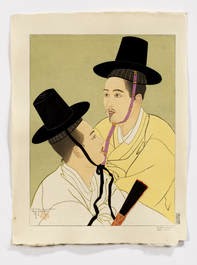
Un artiste voyageur en Micronésie, l'univers flottant de Paul Jacoulet

The Musée du Quai Branly will open an intriguing new exhibition on February 26. Un artiste voyageur en Micronésie, l'univers flottant de Paul Jacoulet explores the work of the noted French printmaker, who traveled to Japan in 1899 and would ultimately spent the greater part of his life there. While in Asia, Jacoulet traveled to Korea, China and Micronesia, which he visited numerous times to paint portraits of the inhabitants. Through his engravings and drawings, he represents the Micronesian men and women he encountered in a sensitive and aesthetically distinctive way that is at once intimate, stylish, and ethnographic. 


Information and images courtesy of the Musée du Quai Branly

Friday, October 12, 2012

Aux sources de la peinture aborigène

The newest major exhibition at the Musée du Quai Branly is devoted to Australian Aboriginal art. Curated by Judith Ryan of The National Gallery of Victoria and Philippe Batty of the Victoria Museum in Melbourne, Aux sources de la peinture aborigène will be the first European retrospective of the painting movement born in Australia's central desert community of Papunya in the early 1970s. While proclaiming the absolutely contemporary character of this indigenous painting style, the exhibition also explores the movement's iconographic and spiritual sources through the presentation of traditional objects and photographs of ephemeral ritual paintings, most notably those taken by Baldwin Spencer.                                          

Visit the exhibition's official website.

Sans titre, Shorty Lungkata Tjungurrayi, 1972

Emu Dreaming, Long Jack Phillipus Tjakamarra, 1972
Men's ceremony (Wati Kujarra), Freddy West Tjakamarra, 1972 
Water Dreaming at Kalipinypa, Walter Tjampitjinpa, 1971
Big Pintupi Dreaming ceremony, Anatjari Tjakamarra, 1972
Decorated knives  -  Australian Aboriginal  -  ca. 1900

Information and images courtesy of the Musée du Quai Branly