Showing posts with label ethnographic art exhibition. Show all posts

Wednesday, May 7, 2014

Tatoueurs, Tatoues

On view at the Musée du Quai Branly beginning May 6, Tatoueurs, tatoués (Tattooists, tattooed) returns to the sources of tattoo and presents the renewal of this phenomenon in its now permanent and globalised manifestation. In so-called "primitive" societies from Asia, Africa and Oceania, tattooing has a social, religious and mystical role and accompanies the subject in their rites of passage, including them in the community. Conversely, in the West, they have been seen as a mark of infamy, criminality, a circus attraction (with the phenomenon of side shows) and as a mark of identity for urban tribes.

View the exhibition's official website.

Wooden head with carved moko  -  Maori, New Zealand


Saturday, April 5, 2014

The New Found Land: Engravings by Theodor de Bry

The New Found Land: Engravings by Theodor de Bry from the Collection of Michael N. Joyner, at the Ackland Art Museum at the University of North Carolina at Chapel Hill until April 13, 2014, highlights prints made by the Franco-Flemish engraver Theodor de Bry (1528–1598) to illustrate the 1590 edition of A Briefe and True Report of the New Found Land of Virginia by Thomas Harriot. De Bry’s images and Harriot’s text offered Europeans a detailed account of the appearance and customs of Native Americans encountered in 1585 by the British settlers on Roanoke Island, off the coast of what is now North Carolina. In addition to the illustrations for Harriot’s book, the installation includes portraits, maps, and other materials related to the so-called “Age of Exploration” 400 years ago, as well as a selection of Native American artifacts.

View the exhibition's official website.


A Weroan or Great Lord of Virginia (detail)  -  Theodor de Bry, published 1590

Image courtesy of the Ackland Art Museum


Sunday, August 25, 2013

Terrestrial Paradises: Imagery from The Voyages of Captain James Cook

An exhibition showcasing engravings of imagery from Cook's voyages to the Pacific Islands and South America is on view now at the University of Miami's Lowe Art Museum. A number of artists accompanied Cook on his three voyages for the Royal Society from 1768-1779, producing images of the peoples they encountered that were reproduced in numerous publications for a European audience fascinated with travel accounts. Terrestrial Paradises: Imagery from The Voyages of Captain James Cook will run through February 9, 2014.


Images courtesy of the Lowe Art Museum


Thursday, July 18, 2013

J’arrive, J’aime, Je m’en Vais – Pierre Loti l’Ambigu Exotique

Through September 29, 2013, the new Atelier Martine Aublet at the Musée du Quai Branly will host a show devoted to the unique and fascinating Pierre Loti (born Julien Viaud). J’arrive, J’aime, Je m’en Vais – Pierre Loti l’Ambigu Exotique (I Arrive, I Love, I Leave – Pierre Loti, the Ambiguous Exotic) is an homage to this late nineteenth-century literary ambassador of exoticism. He was a cosmopolitan dandy who cultivated extravagance and was fascinated by the foreign cultures he encountered in the course of his travels as a naval officer. Conceived by Claude Stéfani, curator at the Municipal Museums of Rochefort, the exhibition includes archival documents, photographs, clothing, and all manner of personal effects. 

View the exhibition's official website.


Image courtesy of the Musée du Quai Branly


Friday, February 22, 2013

Un artiste voyageur en Micronésie, l'univers flottant de Paul Jacoulet

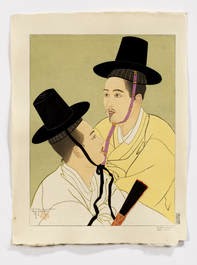
The Musée du Quai Branly will open an intriguing new exhibition on February 26. Un artiste voyageur en Micronésie, l'univers flottant de Paul Jacoulet explores the work of the noted French printmaker, who traveled to Japan in 1899 and would ultimately spent the greater part of his life there. While in Asia, Jacoulet traveled to Korea, China and Micronesia, which he visited numerous times to paint portraits of the inhabitants. Through his engravings and drawings, he represents the Micronesian men and women he encountered in a sensitive and aesthetically distinctive way that is at once intimate, stylish, and ethnographic. 


Information and images courtesy of the Musée du Quai Branly