Thursday, August 19, 2010

African Art World Nestled in Tenafly


TENAFLY, N.J. — You can count the number of American public museums devoted entirely to African art on a few fingers.
There’s the National Museum of African Art in Washington. And the Museum for African Art in New York, reopening in a new Fifth Avenue home next spring. And there’s a third you’ve probably never heard of, the African Art Museum of the SMA Fathers here.
This museum is small and unorthodox in its setting: a stained-glass-windowed hall attached to a Roman Catholic church. But it’s the real African deal, with a collection covering the continent, top to bottom, coast to coast, old to new.
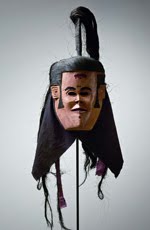
If you’re in New York City, you’ll have to cross the George Washington Bridge to find it. But if you’re looking for visual magic — a Yoruba dance mask with a mini-zoo on top; a brocaded body-wrap from Ivory Coast that seems to float on air; or a 10-foot-high figure of the 1960s Malian soccer hero Salif Keita dressed in team colors and cut from a single tree — you’ll have come to the right place.
And a pretty place it is, the leafy residential campus of a religious order called the Society of African Missions, but better known as the SMA Fathers, with the initials being the order’s name in Latin, Societatis Missionum ad Afros.
The order was founded in Lyon, France, in 1856 by Melchior de Marion Brésillac. A precocious young cleric, he was made a bishop at 29 and set up a network of missions in India before traveling to Africa to do the same. His time there was brief: six weeks after arriving, he died of yellow fever.
But his order was long-lived. It set down roots in present-day Ghana, Ivory Coast, Kenya, Liberia and Tanzania and maintained headquarters in Europe and the United States. The Tenafly seminary, which opened in 1921, was intended as a training center for African-American clergy. The racial politics of the time thwarted that plan, but two decades later, after an infusion of immigrant Irish priests, Tenafly became the SMA’s American home base.
Part of the order’s mandate was to embrace and preserve indigenous cultures. Among other things, this entailed acquiring art wherever it was found in Africa but also commissioning African artists to create new pieces based on Christian themes. One priest, Father Kevin Carroll (1920-1993), an anthropologist and photographer, requisitioned such work from some of the most celebrated Yoruba sculptors of the day.
During a century and a half, the SMA amassed some 50,000 items and built museums to hold them: two in France and one each in Italy and the Netherlands. The Tenafly branch, installed in its present setting in 1980, is now incorporated as a nonprofit institution technically independent of the order and has its own modest holdings of around 1,000 objects. Some came through missionaries, but many were donated by a generous group of local private collectors who have also backed a series of strong thematic exhibitions during the tenure of the museum’s director, Robert J. Koenig.
These donations account for much of what’s in the current show, the first of two year-long permanent-collection displays. They are defined by geography, one of several artificial categories used to package African art for consumption, others being tribes and traditions. But when you have holdings of limited examples of many different kinds of things, what other presentation can you use?
Anyway, geographic delineation is quite approximate here: “Guinea Coast and the Sudan” is really Chad to South Africa. The exhibition labels avoid hard-and-fast alignment of peoples, places and styles. And overarching themes, when introduced, are lightly applied. On the whole this is a show about object-by-object variety.
There are plenty of so-called classic sculptural types. Dan masks from Liberia have Valentine-heart faces exquisite and inscrutable enough to make sense on the streets of Goldoni’s 18th-century Venice. Equally familiar and enchanting are helmet masks carved for Mende women’s societies in Sierra Leone: petite of feature, high of forehead, demure of expression, each an ideal of feminine beauty.
Dogon dance masks depicting birds, antelopes, rabbits and people are the exact opposite of demure. With their paint-freckled surfaces, fiber wigs and movable parts, they’re a chorus of cawing, braying, snuffling, singing beings, visual art as visual noise. You can imagine what they would have looked like on costumed performers in constant motion, twirling, dipping and raising dust.
Baule sculptures of spirit-spouses, embodying the significant others each of us has in the metaphysical realm, are less kinetic in concept but warm up whatever space they’re in — originally the home where they were kept and petted and coddled. The museum has examples of spirit-spouse figures that, set side by side, seem worlds apart but together demonstrate how meaningless, in terms of valuation, distinctions between classical and contemporary can be.
One figure is traditional in appearance, upright, commandingly grave, nude except for a cotton loincloth. The other is a modern urbanite version of the same model but in this case a female figure dressed in shorts and flip-flops, her face fixed in a self-possessed stare. Is one a more authentically superior being than the other? No. They are both, like the towering statue of Salif Keita nearby, high-maintenance spiritual celebrities. In future relationships, they’ll be calling the shots.
As with most Western collections of art from Africa, the one here is made up primarily of wood sculpture. But is this the medium historically most favored in Africa itself?
We’ve come to think so only because we see more carved figures in museums than we do other sorts of things. So it’s nice to see some of those other sorts of things in this show.
There’s metalwork, in which the continent is unbelievably rich, including wrought-iron Yoruba diviner’s staffs fitted with circlets of celestial birds; ponderous silver belts that are the wearable sculptures of the nomadic Tuareg in Sudan; and Ghanaian brass gold-weights, matchbook-size, covered with intricate patterns.
And gold-weights, in turn, seem to have inspired design in another medium, textile weaving. All the brocade on the ethereal Ivory Coast body-wrap take the form of small patches of luminous patterning, no two patches alike. This fabulous textile is now, of course, behind glass, though at some point, decades ago, someone who had reason to feel proud must have worn it, taken it off, put it aside, perhaps tossed it across a bed like the elegant Senufo one in the show, or draped it over a stool, like the timeworn Mossi example in the same display case.
With those two items, we’re back to wood sculpture again, this time as furniture. But in Africa even furniture has a spiritual life: beds and stools absorb the essence of their owners’ souls. Keeping that in mind, the installation of African art in a hall beside a church in a seminary starts to make perfect pan-cultural sense. It certainly makes this museum like very few others.
Source: The New York Times
By: Holland Cotter


Wednesday, August 18, 2010

Magic Masks, Curvy Women From Congo Bewitch in Paris: Review


Congo doesn't have the best reputation.

If the two countries sharing the name of Africa’s second- longest river, the (formerly French) Republic of the Congo and the (formerly Belgian) Democratic Republic of the Congo, pop up in the news, you can bet it’s about civil wars, refugees, abysmal poverty or shameless corruption.

“Fleuve Congo: Arts d’Afrique Centrale,” an exhibition at the Musee du Qui Branly in Paris, presents a more attractive image of that unfortunate region.

The Benedictine monk Francois Neyt, emeritus professor at the Catholic University of Louvain, Belgium, and curator of the show, spent more than 20 years in Africa. He casts his net wide. Besides the two countries mentioned, he includes their neighbors -- Cameroon, Gabon, Equatorial Guinea and parts of Angola -- an area eight times the size of France, stretching from the Atlantic to the Great Lakes in East Africa.

The political frontiers and tribal wars notwithstanding, Neyt is convinced that the vast, outwardly fragmented region shares a common cultural heritage. As proof, he points to cross- border myths, therapeutic rituals, songs and dances.

He also emphasizes sculptures. The 170 pieces, on loan from Belgian and French museums as well as private collectors, are supposed to demonstrate the common roots of the art produced by the Fang in Gabon, the Luba in Katanga, the southernmost part of the Democratic Republic of Congo, and the Chokwe in Angola.

‘Powerful Women’

Neyt exemplifies his theory with the help of three types of sculpture: masks in the shape of a heart, reliquaries with the bones of ancestors and “powerful women.”

The masks are used on various occasions -- initiation rites, circumcisions, necromantic ceremonies and dances. Some are white, others red or ochre. Some have a second pair of eyes, a symbol of prophetic vision. One, representing a sprite of the rain forest, has six eyes.

The guardian figures containing bones of ancestors serve more or less the same purpose as relics of Christian saints: They are believed to possess magical powers protecting against bad luck and evil forces. They come in a confusing variety of shapes; one has the face of a python.

A widespread feature is the diamond-shaped posture of the arms. The figures also are used as title deeds.
The third section is the least convincing. It’s true that the matrilineal transmission of power was the rule in the ancient kingdom of Kongo. Still, it’s hard to believe that “powerful women” with curvaceous bodies and elaborate hairstyles are specific to the Congo region.

Never mind. You can easily enjoy the exquisite beauty of the sculptures without buying into Father Francois’s theoretical edifice.

Just follow the example of Pablo Picasso, who was bowled over when he saw, in 1906, a statuette from the Congo region that his friend Henri Matisse had bought at a curiosity shop on Rue de Rennes. A display case documents the craze for “art negre,” as it was then called, and how the Paris art market responded.

“Fleuve Congo: Arts d’Afrique Centrale,” which is sponsored by Total SA, is at the Musee du Quai Branly, Paris, through Oct. 3. Information: http://www.quibranly.fr or +33-1-5661-7000.

Source: Bloomberg Online, Muse
By: Jorg von Uthmann

Monday, August 16, 2010

Through African Eyes at the Nelson-Atkins Museum of Art Explores African Artists' Perceptions of Westerners

A groundbreaking visual examination of how African artists expressed the dynamic interactions between African cultures and Europeans and Westerners will open Sept. 25 at The Nelson-Atkins Museum of Art. Through African Eyes: The European in African Art, 1500–Present, on view through Jan. 9, 2011, will feature 95 works of art exploring 500 years of contact.

The exhibition, which debuted this past spring at the Detroit Institute of Arts (DIA), is the first to give a wide perspective of the African point of view of Europeans, from first encounters and trade relations, to European settlements and colonization, through the contemporary years of post-independence. Sculptures, masks, utilitarian objects, textiles, photographs and paintings lent from more than 30 museums, institutions and collections give a riveting visual commentary on artistic perceptions from more than 20 African countries.

“These works express an incredible diversity of response to white people, spanning the gamut of emotion from admiration to resentment,” said Leesa Fanning, associate curator, Modern & Contemporary Art, at the Nelson-Atkins, who served as curator for the Kansas City venue.

The exhibition was initiated and curated by Nii Quarcoopome, who leads the Department of Africa, Oceania and Indigenous Americas at DIA. As a child in the 1960s in Ghana, he witnessed first-hand the complex relationships between Africans and white Europeans and Americans.

“At the heart of the exhibition and its accompanying catalogue is the desire to give agency to African voices; indeed, the title, Through African Eyes, primarily obtains from this thinking,” he said. “After all, what good is African art and history without the African voice?”

The works of art generally take three forms. First are the portraits of specific Europeans or images that represent a particular moment in time; next are images of white people as a metaphor or allusion to authority, power, brutality, wealth, literacy, etc.; and finally, there are utilitarian objects that Africans used to denote European or Western culture, such as guns, books and eyeglasses.

“At first, because Africans encountered Europeans only as occasional visitors to their communities, white people remained exotic characters,” Quarcoopome wrote in the catalogue. “But once Europeans decided to settle among Africans, African attitudes changed toward them as a people and culture. Increased familiarity eroded much of the initial fascination and enabled Africans to more fully assess the racial and cultural differences.”

The exhibition is organized in seven sections:

Strangers and Spirits: Histories passed down through generations of Africans tell of various reactions to first meetings with Europeans. The arrival of the Portuguese around 1450 created a sensation. In many African cultures, whiteness is traditionally associated with the supernatural and spirits. African sculptures with white pigment surfaces are instantly recognized by Africans as representing spirits. With their pale skin, the Portuguese were first thought to be supernatural beings. This sculpture represents an ancestor spirit. It was used as a grave marker and it functioned as a mediator between the living and the dead. The figure has filed teeth characteristic of Yombe peoples but wears European-style clothes.

Traders: Direct partnerships between Portuguese traders and African kingdoms resulted in a long-lasting impact on African arts and cultures. African artists incorporated European imagery, imported materials and goods. Objects in this section show the European as a trader of goods and slaves–lucrative for some, destructive for others.

Settlers: Although European settlers lived apart from their African neighbors, Africans observed them closely. These works reveal the results of those observations, such as the sculpture of the couple walking their dog (first page of release) by the Yoruba artist Thomas Ona Odulate, who documented colonial life in his carvings. In African culture, dogs perform functional roles, such as hunting and providing protection. With this sculpture, the artist makes a commentary on the European lifestyle – dog walking as a leisure activity – and represents an African stereotype of European culture in which love for dogs trumps that for humans.

Spirituality and Technology: Africans usually admired and welcomed European technologies. Artists here reflect the desire to own or be associated with European technology, but also express caution about its use. This work, Fantasy Coffin, a sculpture of a Mercedes Benz from 1996 by the Ghanaian artist Ben Kane Kwei, would have been commissioned to celebrate a life of wealth and achievement, provide an elegant ride for the deceased in the afterlife and fulfill the lifetime fantasy of owning such a car.

Education: The introduction of Western teachings created tensions within African societies, and many Africans saw access to Western education as a way to influence and resist European ways of understanding the world.

Colonizers: In the late 1800s representatives from 12 European countries divided Africa into colonies and established themselves as masters. Works here reveal how African artists expressed their attitudes toward colonizers from resistance to alignment. Between the 1950s and 1960s, as Africa’s boundaries were redrawn and independent nations appeared, artists created works of art reflecting on the era of colonization with feelings that ranged from deeply critical to nostalgic.

Westerners: African artistic interpretation of the West continues today. This section features art forms that reflect the ongoing complex interaction with the world.

This exhibition has been organized by the Detroit Institute of Arts. Generous support has been provided by the Friends of African and African American Art, the DTE Energy Foundation, the National Endowment for the Humanities and the National Endowment for the Arts. In Kansas City the exhibition is supported by The Helzberg Fund for African Art.


Monday, August 9, 2010

Tour planned for Gaddafi's summit hits problems


Royal Museum for Central Africa in Tervuren, Brussels is worried about sending its collection of wooden sculptures to Africa

BRUSSELS - A planned tour of a major exhibition of African art to Libya, currently on show in Belgium, is now under threat. Masterminded by Tanzania-born British architect David Adjaye, the show was due to open in Tripoli for the European-African summit in November, hosted by Colonel Gaddafi.

"Geo-graphics: a Map of Art Practices in Africa, Past and Present," at the Bozar centre in Brussels (part of the "Visionary Africa" festival until September 26), has at its heart 220 pieces of traditional African art (16th to 20th century), loaned by the Royal Museum for Central Africa in the Brussels suburb of Tervuren and Belgian private collectors. These are joined by contemporary art from eight organizations in Africa, as well as architectural photographs by Adjaye of 17 African capitals.

The main challenge has been to send the wooden sculptures from the Royal Museum on tour. The plan was that the museum would lend around a quarter of its 120 works currently at Bozar to Tripoli, and then to Addis Ababa (Ethiopia), Ouagadougou (Burkina Faso) and four further African venues. This was a generous move in light of a situation in 1967, when it lent sculptures
to the national museum in Kinshasa (Congo) and 90 out of 114 works were stolen.

Now the Tervuren museum wants to make a fresh start in developing relations with Africa. Curator Anne-Marie Bouttiaux told us the traveling show is "very important, so I will fight for it." She added that traditional art from sub-Saharan Africa has never been exhibited in Libya.

But the €300,000 pledged by the European Commission for the first three venues of the African tour is insufficient, and it is proving hard to find venues with appropriate environmental and security conditions. None of the Tripoli museums seem suitable, so the organizers are looking at government buildings associated with the summit.

The director of the Visionary Africa festival, Nicola Setari, said: "Although there is an ambition to present traditional art, that is proving beyond our capacity." Hopefully photographs and some contemporary art will still go to Tripoli, along with a smaller selection of traditional art, but much will depend on what Gaddafi's authorities can provide in support.

Source: The Art Newspaper
By: Martin Bailey

Art Exhibit examines photography's role in the changing perception of African items from artifacts to art

The University of Virginia Art Museum will present "Man Ray, African Art, and the Modernist Lens," a groundbreaking exhibition exploring the pivotal role of photography in changing the perception of African objects from artifacts to fine art, from August 5 through Oct. 10.

The exhibition brings to light photographs of African objects by American artist Man Ray (1890-1976) produced over a period of almost 20 years. In addition to providing fresh insight into his photographic practice, the exhibition raises questions concerning the representation, reception and perception of African art as mediated by the camera lens.

Featured are more than 50 of Man Ray's photographs from the 1920s and 1930s alongside approximately 50 photographs by his international avant-garde contemporaries such as Charles Sheeler, Walker Evans, Alfred Stieglitz and André Kertész.

For the first time, a number of these photographs are presented alongside the original African objects they feature. The juxtaposition offers a rare opportunity to encounter first-hand how various photographic techniques of framing, lighting, camera angle and cropping evoke radically different interpretations of these objects. Books, avant-garde journals and popular magazines also on display illustrate how these photographs circulated and promoted ideas about African art and culture to an international audience.

Curated by photo historian and author Wendy Grossman and organized into four sections, the exhibition frames the objects and images within diverse contexts, including the Harlem Renaissance, Surrealism and the worlds of high fashion and popular culture.

African Art, American-Style

The first section presents an overview of the embrace of African art in the United States in the first decades of the 20th century. Images of African objects by American photographers, ranging from the New York avant-garde to artists of the Harlem Renaissance, reveal different understandings of African art and culture. The photographs shed light on issues of identity, gender and colonialism influenced by the country's history of slavery, segregation and disenfranchisement.

African Art in the Age of Mechanical Reproduction

Examining different print contexts in which photographs of African objects were reproduced, this section demonstrates how advances in print technologies in the first decades of the 20th century and the burgeoning of mass media played a critical role in transmitting the vogue for African art. At the crossroads of art and documentation, the works in this section reveal how the camera lens served as a prism though which a large audience first experienced African art.

Surrealism and Beyond

Photography's controversial status as an art form and its ability to blur boundaries between dream and reality enhanced its appeal for Man Ray and his fellow Surrealists. Several of Man Ray's photographs and works by artists active in Germany, England and Czechoslovakia reflect the Surrealists' preoccupation with myth, ritual and the unconscious. This section explores how African and other non-Western objects functioned within the Surrealist world view.

Fashioning a Popular Reception

The intersection of vanguard taste, fashion and interest in African art is epitomized by the works in this section: Man Ray's now-iconic photograph "Noire et blanche"; his series of fashion photographs "Mode au Congo," featuring models in Congolese headdresses; and images of writer, shipping heiress and collector of African objects Nancy Cunard. As the works in this section illustrate, Man Ray created images representing the intersection of African art, photography and high fashion.

Exhibition Catalog

A fully illustrated, 184-page catalog accompanies the exhibition. Written by Grossman and edited by Martha Bari, with contributions by Ian Walker, Yaëlle Biro, Poul Mørk, Rainer Stamm, Thomáš Winter and a number of prominent African art scholars, the catalog is published by International Arts & Artists and distributed by University of Minnesota Press.

"Man Ray, African Art, and the Modernist Lens" was organized by International Arts & Artists of Washington, D.C. The exhibition was funded in part by grants from the Terra Foundation for American Art, the National Endowment for the Arts, and the Dedalus Foundation.

International Arts & Artists is a non-profit arts service organization dedicated to increasing cross-cultural understanding and exposure to the arts internationally through exhibitions, programs and services to artists, arts institutions and the public.


Source: newsleader.com


Thursday, August 5, 2010

'A Brave New World' at the African Art Museum


August 9, 2010 - April 24, 2011

The National Museum of African Art celebrates its 2008 acquisition of the mesmerizing, video-based artwork 'Brave New World II' (by Theo Eshetu) with a small, focused installation of contemporary works from its permanent collection that examines the theme of travel. In this new world, grainy film footage of dancers performing in a restaurant in Bali join stencils of body builders and prints named after Bob Dylan tunes to give vision to the very real, global experiences of African artists.

Source: African Art Museum website

Sunday, August 1, 2010

Nigeria's art collectors: A niche new market


In a suburb of Lagos, Nigeria's business capital, Yemisi Shyllon lives in a house full of bronze statues of African tribal rulers and brightly colored beadwork landscapes. He may be Nigeria's biggest art collector, with some 6,000 pieces by his count. "I don't go out much," he says, "I have enough to look at here."

Mr. Shyllon, who runs an engineering company, is one of a small circle of Nigerian businessmen who own huge collections of local art. Sammy Olagbaju, a 70-year-old retired stockbroker who has lived in London and New York, is another avid collector. One Lagos-based banker has over 600 pieces.

With 250 ethnic groups and around 150 million people, Africa's most populous country has many sources of artistic inspiration. A number of artists from western Nigeria use the bright colors and beadwork of the Yoruba, south-east sometimes look to their region's uli style, with simpler drawings on walls or pots.

The collectors say their government cares little about preserving this artistic heritage. They share the cynicism of many Nigerians, who think the politicians are more eager to grab a share of the revenues of sub-Saharan Africa's biggest oil producer. Instead, the collectors prefer to put their own money into gathering and cataloguing thousands of works of art. "For me, this is a philanthropic act," says Mr. Olagbaju, who notes that Nigeria's top public galleries struggle with power cuts that leave masterpieces gathering dust in the dark.

More recently, these collectors have realized that they have also been canny investors. Their hobby has started to attract foreign attention - and cash. At an auction of African art in New York in March, the five most expensive lots were Nigerian. A painting by the late Ben Enwonwu went for $91,000.

Some buyers are speculating that the Nigerian works are still undervalued. Giles Peppiatt, director of contemporary African art at Bonhams, a British auction house that hosted the New York sale, says prices will rise in this niche market.

Auctions are also happening in Lagos, where oil and banking have made a few very rich, though most people still live in grinding poverty. "There's a lot of money in Nigeria," says Mr. Peppiatt. "And though it might sound cynical, money and art are inextricably linked."

Source: The Economist Online